
Hospital’s Negligence Allowed a Car to Plow Through the Front Door into Young Family
A hospital neglected to install bollards in front of its ER. An intoxicated driver drove into the building, horrifically injuring a family.
Watch the Case FeatureA hospital in Austin, Texas, owed its emergency room visitors a duty to keep the entrance reasonably safe from known or foreseeable hazards. However, the hospital left its façade exposed to vehicles driving immediately in front of it. No bollards. No protection. That failure allowed an intoxicated driver to speed through the hospital’s glass entryway and into the lobby. Inside, the Bernard family — a mother, father, and their two young sons — were standing near a large aquarium. In an instant, the unprotected entrance became the point of catastrophic impact for an entire family.
The collision turned the ER lobby into a scene of chaos. The vehicle blasted through the glass doors and into the aquarium area, striking the family with tremendous force. Water, sand, debris, and inch-thick shards of glass scattered throughout the waiting room. Both children experienced severe physical trauma, including embedded glass and sand that required multiple surgeries. One child also sustained serious facial injuries and later developed seizures. The mother suffered fractures that required surgical stabilization and was left with chronic pain and tinnitus. Both parents also suffered traumatic brain injuries and PTSD. The family’s medical care became extensive, long-term, and life-altering, with damages reaching far beyond the immediate emergency response.
While the family was still recovering, they turned to Sean Breen, a partner at Howry, Breen & Herman, LLP, for help. Sean was well-suited to handle the matter because of his firm’s experience litigating serious premises liability and vehicle-intrusion cases involving preventable safety failures. From the outset, he approached the case not as an unavoidable accident, but as a foreseeable and preventable event. He began by meeting with the family, examining the incident scene, and investigating how the crash occurred: what safeguards were missing and whether the hospital system had known about the risk.
That investigation uncovered a broader pattern. Sean learned that the parent organization had experienced similar intrusions at other facilities and had already installed bollards at some emergency room entrances elsewhere. He also found evidence that the hospital maintained bollard inspection practices and had access to an inspector near the premises before this incident. The case therefore became not just about one crash, but about corporate knowledge of a recurring and preventable risk.
The defense tried to frame the event as solely the intoxicated driver’s fault and argued that no law specifically required bollards at this entrance. They also sought to minimize the hospital’s role and limit damages. The core dispute became whether this was simply an isolated driving event or a preventable injury made worse by the hospital’s failure to install inexpensive protective barriers.
Sean responded with a strategy focused on foreseeability, reasonableness, and prevention. He retained treating doctors and other experts to explain the family’s injuries, long-term prognosis, bollard standards, and intrusion statistics. But the key challenge was showing how simple barriers would have changed the outcome of the incident. To do that, Sean brought in DK Global early to develop demonstratives that made both liability and damages clear. DK Global created two primary presentations: one on preventability and another on the family’s injuries.
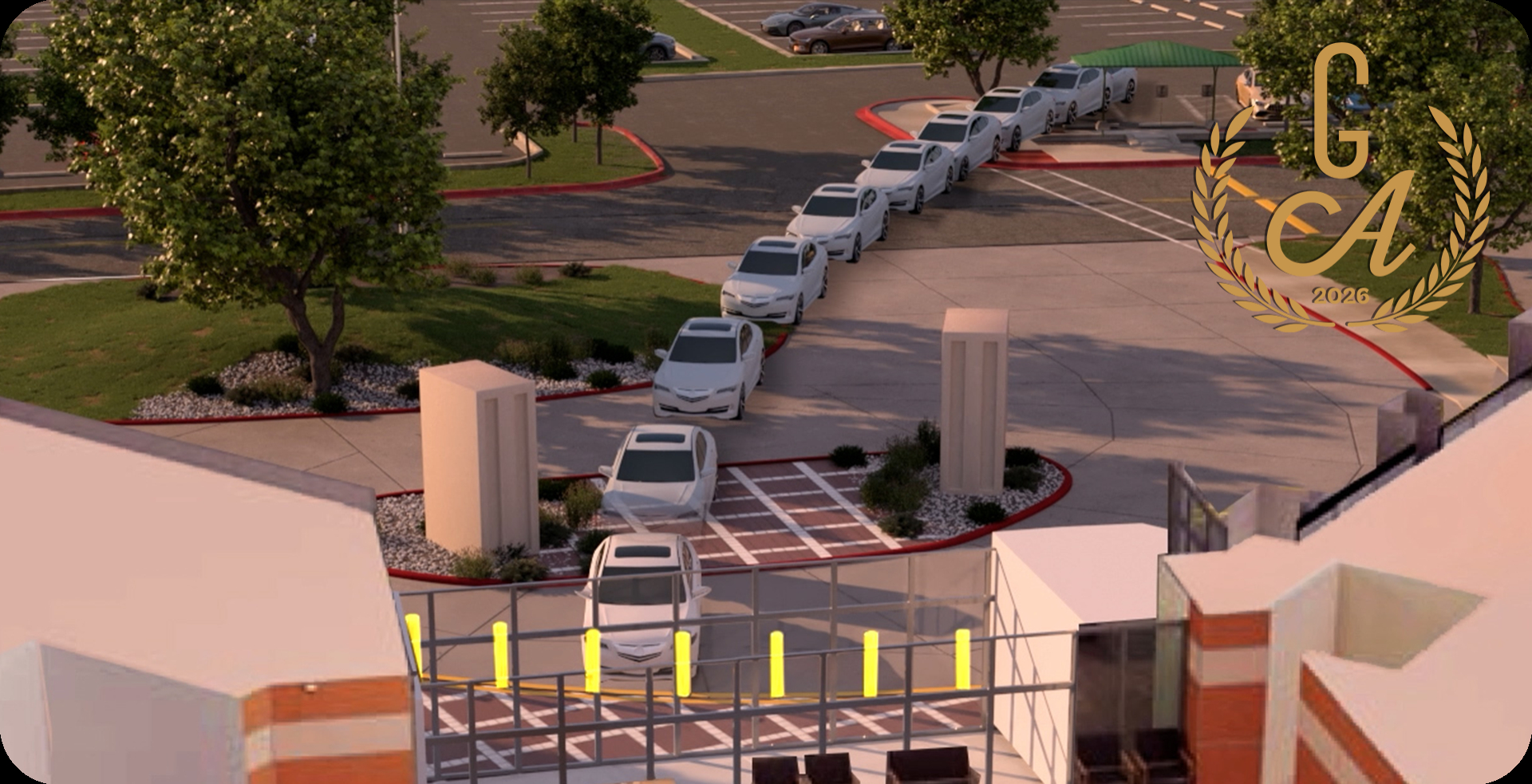
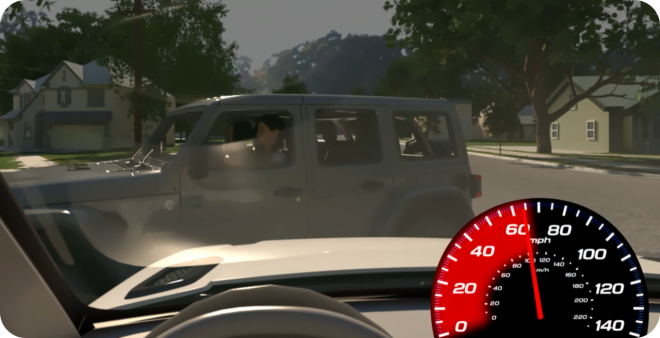
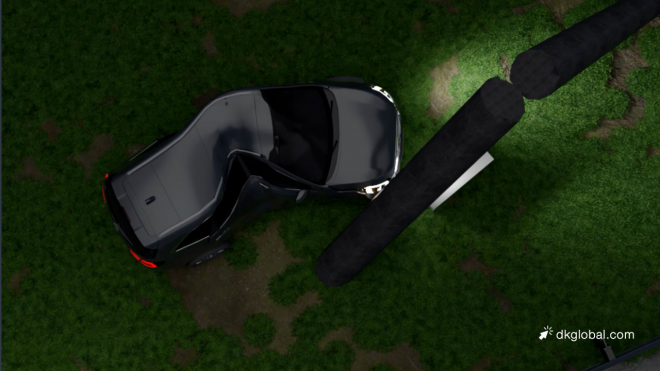
The liability presentation began with actual security and witness footage showing the crash and its aftermath. It then widened the frame with infographics mapping similar vehicle intrusions at medical facilities and other locations across the United States, underscoring that these incidents were frequent and foreseeable rather than, not rare anomalies. From there, the presentation introduced 3D renderings of bollards placed over the real-world scene to demonstrate where protective barriers could have stood at the ER entrance. The sequence then advanced into a 3D reconstruction showing the vehicle’s path into the lobby and illustrating how properly installed bollards would have intercepted the car before it struck the family. The damages presentation followed by identifying each family member’s injuries individually. It used 3D medical illustrations, imaging correlations, and anatomy-based visuals to show traumatic brain injuries, fractures, lacerations, pain syndromes, and other lasting consequences. It also recreated Nadia Bernard’s leg surgery to show the seriousness of her orthopedic injuries and the invasive treatment required after the crash.
Sean used these presentations repeatedly as the case moved forward, including during depositions, case presentations, and mediation efforts, to demonstrate both the strength of the liability case and his readiness for trial. The visuals sharpened the central argument: this was not simply a drunk-driving case, but a preventable premises case against a hospital system that knew the danger and failed to act. As trial approached, the defense’s posture changed. Rather than continue relying solely on driver blame and the absence of a specific bollard law, attention shifted toward resolution. Approximately one month before trial, the case settled confidentially on terms that provided long-term care and support for the Bernard family. The outcome also had effects beyond the litigation itself, contributing to broader bollard adoption and local policy changes aimed at preventing similar tragedies in the future.
As a founder of Howry, Breen & Herman, LLP, Sean Breen has achieved multiple seven- and eight-figure recoveries for his clients. He specializes in accident, personal injury, premises liability, and brain injury/paralysis cases. He has been named among the nation’s most respected high-stakes trial lawyers based on his verdicts and settlements, earning the 7 Figure Litigators® and 8 Figure Litigators® awards from America’s Premier High-Stakes Litigators® in 2020. He has repeatedly been recognized for his accomplishments by Best Lawyers in America®, Top 50 US Verdicts, Texas Verdicts Hall of Fame, Multi-Million Dollar Advocates Forum, National Top 100 Trial Lawyers, Civil Plaintiff, and Super Lawyers®.
If you have better tools to tell the story and the story resonates, you're going to get results. And that to me is the simple equation why I use DK Global — get better results.
 Animation
 Animation